
Bird of the Month: Clark's Nutcracker
Few birds are more closely tied to the Rocky Mountains than the Clark's Nutcracker (Nucifraga columbiana). Intelligent, resourceful, and remarkably hardy, this striking gray-and-black bird has become one of the defining species of the high-elevation forests of western North America. Whether calling loudly from the top of a lodgepole pine, gliding across an alpine meadow, or carefully burying seeds for the coming winter, Clark's Nutcrackers are true masters of mountain life.
Unlike many birds that rely on migration to escape harsh winters, Clark's Nutcrackers remain in the mountains year-round. They survive some of the most extreme weather conditions in North America by doing something extraordinary: they become living seed banks. Throughout late summer and autumn, a single Clark's Nutcracker can collect and hide tens of thousands of pine seeds in hundreds or even thousands of carefully chosen locations. Months later, often beneath several feet of snow, they can remember many of those hiding places with astonishing accuracy.
Their story is inseparable from that of high-elevation pines. In fact, scientists consider Clark's Nutcracker one of the most important forest regenerators in the Rocky Mountains. Every forgotten cache of seeds has the potential to become the next generation of pine trees, making this bird an essential partner in maintaining healthy mountain ecosystems.
Clark's Nutcracker also has an important place in American history. The species was first documented during the famed Lewis and Clark Expedition. In 1805, while traveling through what is now Idaho, explorer William Clark collected the first scientific specimen. The bird was later formally described by ornithologist Alexander Wilson, who honored Clark by naming the species after him. Today, it remains one of the few North American birds directly connected to one of the nation's most famous expeditions.
For bird lovers visiting Colorado's mountain forests, spotting a Clark's Nutcracker is often a highlight of the trip. Their bold personalities mean they frequently approach hikers, picnic areas, and overlooks in search of an easy meal. While they should never be intentionally fed by hand, their confidence allows for wonderful viewing opportunities.
Perhaps more than any other western bird, the Clark's Nutcracker reminds us that every species plays a role in shaping the landscape. Without these birds planting millions of pine seeds each year, many of the forests we enjoy today might look very different.
Quick Facts
Family: Corvidae (Crow and Jay Family)
Length: 11–12 inches
Wingspan: 22–24 inches
Weight: 3.7–5.7 ounces
Average Lifespan: Up to 17 years in the wild
Habitat: High-elevation conifer forests, subalpine woodlands, alpine edges
Diet: Pine seeds, insects, berries, nuts, carrion, bird eggs, small vertebrates
Conservation Status: Least Concern
Identification
Clark's Nutcrackers are medium-sized birds with sturdy bodies and strong, pointed bills perfectly adapted for extracting pine seeds.
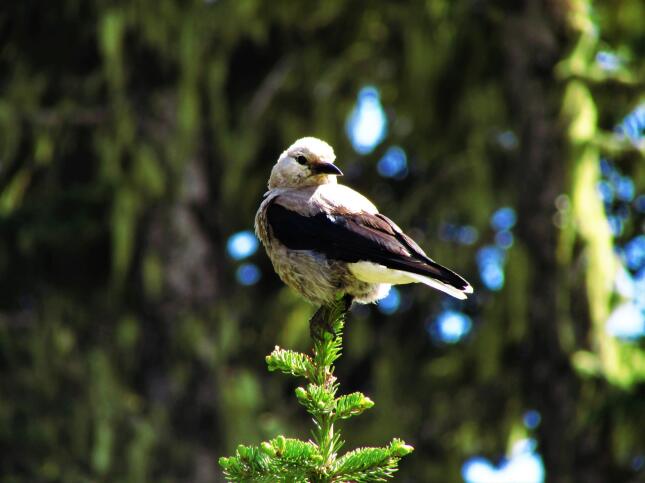
Unlike the colorful Steller's Jay or Blue Jay, their plumage is relatively understated. Most of the body is a soft ash gray with contrasting black wings and a black tail. Bright white outer tail feathers become especially noticeable during flight, creating a striking flash of white against the dark wings.
Their bill is long, straight, and dagger-like, allowing them to pry seeds from tightly closed pine cones. Their legs and feet are powerful, enabling them to climb through branches and cling to pine cones while feeding.
Both males and females look nearly identical, making them difficult to distinguish in the field. Juveniles resemble adults but often appear slightly duller with softer feather edges.
Their flight is direct and powerful, consisting of steady wingbeats punctuated by short glides. While soaring over mountain valleys, they often resemble small crows.
Habitat and Range
Clark's Nutcrackers inhabit the mountainous regions of western North America from southern Canada through the Rocky Mountains and Sierra Nevada into northern Mexico.
In Colorado, they are most commonly found between 7,000 and 12,000 feet in elevation, although seasonal food availability may bring them to lower elevations during some years. I remember them coming down to Colorado Springs durring the years of the Hayman Fire.
Their preferred habitats include forests dominated by:
Limber Pine
Whitebark Pine
Ponderosa Pine
Lodgepole Pine
Engelmann Spruce
Douglas-fir
The birds spend much of the year near pine forests where they harvest seeds. However, they also venture into alpine meadows, rocky ridges, campgrounds, ski areas, and mountain communities.
Unlike many mountain birds that descend during winter, Clark's Nutcrackers often remain at high elevations throughout the year, relying on their carefully stored food caches to survive deep snow and freezing temperatures.
Food Preferences and Feeding Behavior
Clark's Nutcrackers are opportunistic omnivores, but pine seeds are unquestionably their favorite food.
Their long, pointed bills allow them to pry open cones and extract nutritious seeds. Beneath the tongue is a remarkable expandable pouch called a sublingual sac. This natural "shopping bag" allows a single bird to carry as many as 90 to 100 pine seeds at one time before flying off to bury them.
During late summer and fall, these birds become incredibly busy. A single Clark's Nutcracker may cache more than 30,000 seeds before winter arrives. They carefully bury seeds a few inches beneath the soil, often selecting sunny slopes where snow melts earlier in spring.
Their memory is extraordinary. Researchers estimate they can relocate a large percentage of their caches months later, even after heavy snowfall has completely altered the landscape.
Although pine seeds dominate their diet, Clark's Nutcrackers are highly adaptable. They also consume insects, beetles, caterpillars, grasshoppers, berries, acorns, small reptiles, carrion, bird eggs, and occasionally nestlings. Around campgrounds, they may investigate unattended food, though visitors should always store food securely and avoid feeding wildlife.
This varied diet allows Clark's Nutcrackers to thrive in an environment where food availability changes dramatically with the seasons.
Courtship and Mating
Clark’s Nutcrackers form long-term pair bonds, often staying with the same mate for many years. In fact, some pairs may remain together for life. Courtship is not flashy in the way hummingbirds or grouse might perform dramatic displays. Instead, it is built around cooperation, territory defense, and shared survival strategy in a demanding mountain environment.
During courtship, pairs often engage in mutual feeding and synchronized movements through the forest canopy. Males may present food items to females, reinforcing the pair bond. Vocalizations also play an important role, with soft calls used between mates during the breeding season. These interactions help strengthen the partnership that will be essential for nesting and raising young in a landscape where food availability can be unpredictable.
Breeding typically begins in late winter or very early spring, often while snow is still deep in the mountains. This timing is closely tied to their reliance on cached seeds. Because food has been stored throughout the previous autumn, Clark’s Nutcrackers can begin nesting earlier than many other high-elevation birds.
Nesting usually takes place in dense coniferous forests, often in mature pines or spruces that offer both concealment and stability. Nests are typically built high in trees, anywhere from 10 to 40 feet above the ground.
The nest itself is a relatively sturdy open cup structure constructed from twigs, bark strips, grass, rootlets, and moss. The interior is lined with softer materials such as feathers, fur, and fine plant fibers. Both members of the pair may participate in nest construction, though females typically take the lead in shaping and finishing the nest.
Because Clark’s Nutcrackers often begin nesting when temperatures are still cold, nest placement and insulation are especially important. The structure must protect eggs and chicks from wind, snow, and fluctuating temperatures common at high elevations.
A typical clutch consists of 2 to 4 eggs, which are pale greenish or grayish with darker speckling. The female is primarily responsible for incubation, which lasts approximately 16 to 18 days. During this time, the male provides food and helps defend the nesting territory.
Once the eggs hatch, both parents become highly active caregivers. The chicks are born helpless, with closed eyes and very limited ability to regulate body temperature. At this stage, constant attention is required to keep them warm and fed.
Unlike many birds that rely heavily on insects to feed their young, Clark’s Nutcrackers often incorporate stored pine seeds into the diet of nestlings, along with insects and other protein-rich food. Adults may retrieve cached seeds or forage widely to meet the nutritional demands of rapidly growing chicks.
As the nestlings develop, their growth is steady but not especially rapid compared to some smaller songbirds. Feathers begin to emerge within the first week, and by the second week they become noticeably more active and vocal within the nest.
Young Clark’s Nutcrackers typically fledge at around 18 to 21 days after hatching. At this point, they leave the nest but are not immediately independent. Instead, they remain with their parents for an extended period, learning essential survival skills.
This post-fledging period is critical. Juveniles must learn how to locate, harvest, and most importantly, cache pine seeds with precision. This skill is not instinctual alone; it is refined through observation and practice. Young birds follow adults as they bury seeds, gradually learning to recognize suitable caching sites and retrieval strategies.
It can take weeks or even months before juveniles become fully proficient. During this time, family groups may remain together, moving through the forest in search of food resources.
Tips for Spotting Clark’s Nutcracker
In Colorado’s high country, Clark’s Nutcrackers are often easiest to find in late summer through early fall, when they are actively harvesting and caching pine seeds. Look for them in subalpine forests dominated by whitebark, limber, or lodgepole pine.
Their call is one of the best field clues: a sharp, nasal “kraaah” or “kreep” that carries across mountain valleys. Once learned, this vocalization often reveals their presence long before they are seen.
They are also highly curious and will sometimes approach hikers, especially in campgrounds or picnic areas where food smells are present. While this can lead to excellent viewing opportunities, it is important not to feed them, as human food can disrupt their natural foraging behavior.
Conservation Concerns
Clark’s Nutcrackers are currently considered a species of Least Concern, but their long-term outlook is closely tied to the health of high-elevation pine ecosystems.
One of the most significant threats they face is the decline of whitebark pine, a keystone species in many western mountain ranges. Whitebark pine has been heavily impacted by a combination of factors, including blister rust disease, mountain pine beetle outbreaks, and climate change.
Because Clark’s Nutcrackers rely on these trees for food and caching sites, any decline in pine populations can have cascading effects on bird populations and forest regeneration.
Ironically, the relationship between nutcrackers and pines is also part of the solution. By caching seeds and forgetting a portion of them, nutcrackers help regenerate pine forests naturally. This mutual dependency makes them a vital part of long-term forest resilience.
Climate change may also shift the distribution of suitable habitat, pushing both pines and nutcrackers to higher elevations over time.
Role in the Ecosystem
Clark’s Nutcrackers play a critical ecological role as seed dispersers and forest engineers. Their caching behavior directly contributes to the regeneration of high-elevation pine forests.
Each forgotten seed has the potential to grow into a new tree, meaning that nutcrackers are effectively planting forests across vast mountain landscapes. This relationship is one of the most important examples of mutualism in North American ecosystems.
Beyond seed dispersal, they also help regulate insect populations and serve as both predator and prey within alpine food webs.
Bird Feeding Connections
Clark’s Nutcrackers are not typical backyard feeder birds, but they may occasionally visit feeders in mountain communities, especially when natural food sources are scarce.
If they do appear, they are most likely to take:
Peanuts (shelled or in the shell)
Sunflower seeds
Suet in colder months
However, feeding should always be avoided in wild settings, particularly in national parks and forest areas where wildlife management policies prohibit it.
For most bird watchers, the best way to support Clark’s Nutcrackers is by preserving native pine forests and protecting high-elevation habitats.
Clark’s Nutcracker is far more than a mountain bird. It is a living link in the survival of entire forest ecosystems. Through intelligence, memory, and relentless preparation for winter, this species not only survives some of the harshest environments in North America but actively helps shape them.
Watching a Clark’s Nutcracker move through a high-elevation pine forest is witnessing ecological partnership in action. Every seed buried, every forgotten cache, and every call echoing across the mountains contributes to the future of the forest itself.
In many ways, the Clark’s Nutcracker is not just a resident of the Rockies. It is one of their architects.